
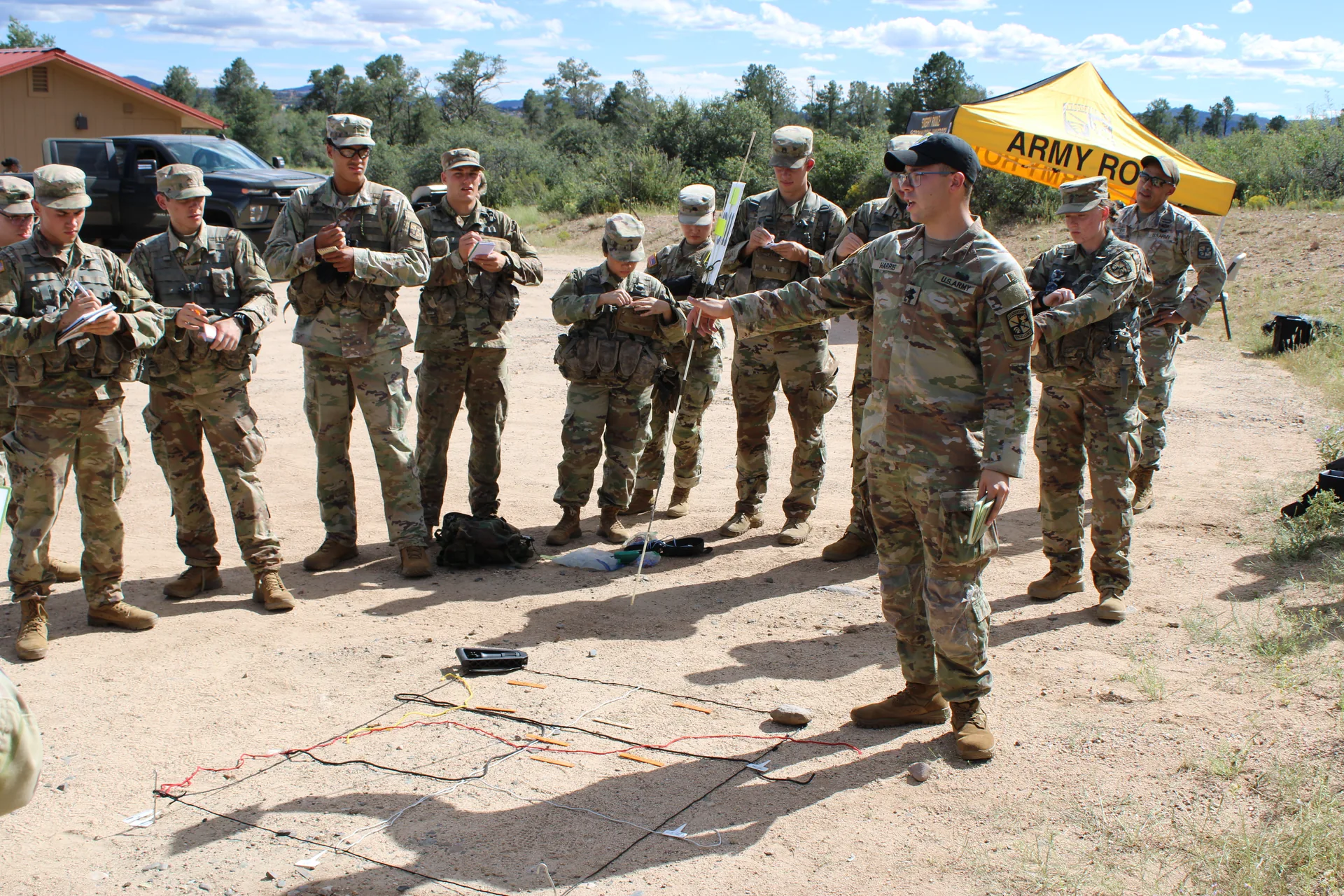
An Army officer is a leader within one of the most respected institutions in America. Since 1916, over 1,000,000 lieutenants have come from Army ROTC, which produces 70 percent of the Army's new lieutenants.
Embry‑Riddle's Army ROTC is one of the largest programs in the Southwest. Top cadets can attend special camps like Air Assault and Jungle Camp, and all cadets complete basic and advanced training during the summer.
Army ROTC is an elective course that prepares you for a commission in the U.S. Army, allowing you to test the program for up to two years without obligation. While pursuing your degree, you'll gain skills applicable to both military and civilian careers. The program includes leadership development, military skills and field training.
Become a Leader in ROTC
LEAD THE FUTURE.
Find out what it takes to lead as an Army Officer.
SUCCEED AS A LEADER.
As a commissioned Officer, you’re not only a leader who guides, problem-solves, and plans for upcoming missions, but you’re also empowered to make decisions that can have impact across the globe.
Lead with authority and respect
Apply leadership skills and expertise
Conduct real-world missions
Train and mentor junior Soldiers
GRADUATE AS AN OFFICER WITH ARMY ROTC.
Earn college scholarships, develop leadership skills, and advance your military career while on campus with the Army Reserve Officers’ Training Corps (ROTC).
Graduate with a secure career as a commissioned Officer
Start at the rank of second lieutenant
Complete Officer training and other certifications during the summer
GROW BEYOND YOUR SERVICE
When you’re an Officer in the Army, the ability to grow your career doesn’t stop. You can have a fulfilling lifelong career with many opportunities for training and advancement. Becoming an Officer will also help you if you decide to enter the civilian workforce, as employers place a high value on workers who can lead others in challenging situations.
Who is Army ROTC for?
High school graduates, enrolled college students and eligible Soldiers can explore different routes into Army ROTC. Contact the battalion to determine the right pathway.
Why Prescott?
Combine the Embry-Riddle Prescott academic experience with practical leadership training, physical readiness and field exercises in northern Arizona.
The Department of War and Service Branches do not endorse any company or sponsor, or their products or services.
This Official U.S. Government Internet site is provided as a public service by Army ROTC Eagle Company, Lumberjack Battalion and the IT department at Embry‑Riddle Aeronautical University. It is intended for use by the public for viewing and retrieving information only. Unauthorized attempts to upload information or change information on this service are strictly prohibited and are punishable under the rules of this university, the Computer Fraud and Abuse Act of 1986, and other state and federal laws. Unless otherwise indicated, all information is public information and is available to copy or distribute. Use of this system constitutes consent to security testing and monitoring. The views expressed in educational research, studies, analysis or commentary are those of the author and do not reflect the official policy or position of the U.S. Army, Department of Defense, U.S. Government or this educational institution.
Learn More About Army ROTC
Army ROTC will give you valuable real-world tools and leadership skills that will benefit not only your professional career but your personal life as well.
In college, Army ROTC classes normally involve one elective class and one lab per semester. Although the classes involve hands-on fieldwork as well as classroom work, they are standard college classes that fit into a normal academic schedule.
Physical Fitness occurs 3-5 days per week. A Fall Semester Field Training Exercise (FTX), and a Spring Semester Field Training Exercise (FTX) are routine training events planned but fluctuate with academic year.
Army ROTC is an elective curriculum alongside your required college classes. It prepares you with the tools, training and experiences that will help you succeed in any competitive environment. Additionally, Army ROTC can pay for your college tuition too. You will have a normal college student experience like everyone else on campus, but when you graduate, you will be an Officer in the Army.
Being an Officer in the U.S. Army means you’re a leader, a counselor, a strategist and a motivator. As an Officer, you will lead other Soldiers in all situations and adjust in environments that are always changing. You’ll be driven to achieve success with your team on every mission.
Army ROTC is a one-of-a-kind experience. The challenges you face and the obstacles you’ll overcome will prepare you for future success.
EXTRACURRICULARS: CADET LIFE, CULTURE, AND COMMUNITY
RANGER CHALLENGE
COLOR GUARD
BATAAN MEMORIAL DEATH MARCH
STUDENT GOVERNMENT, ORGANIZATIONS, AND CLUBS
VOLUNTEER WORK
INTERNSHIPS
MILITARY COUNCIL AND ALUMNI
A Typical ROTC Day and Week
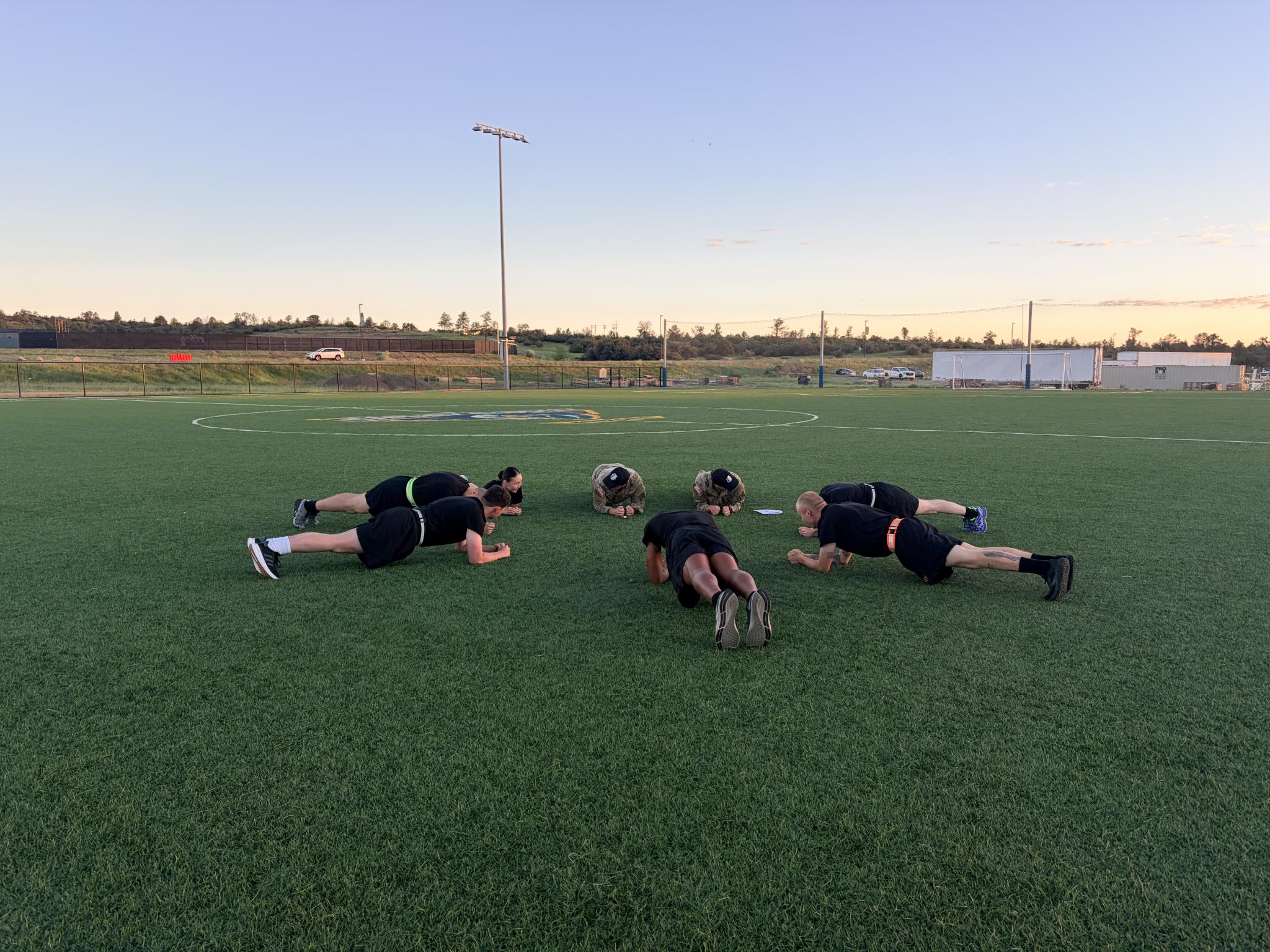
A training day may begin with morning physical training (PT), followed by academic classes. Military science class builds leadership knowledge, while Leadership Laboratory (LLAB) provides practical team training on scheduled days. Field Training Exercises (FTX) occur periodically, rather than daily.
Physical training is scheduled 3–5 days per week. Fall and spring field training exercises and other commitments follow the battalion’s academic-year training schedule.
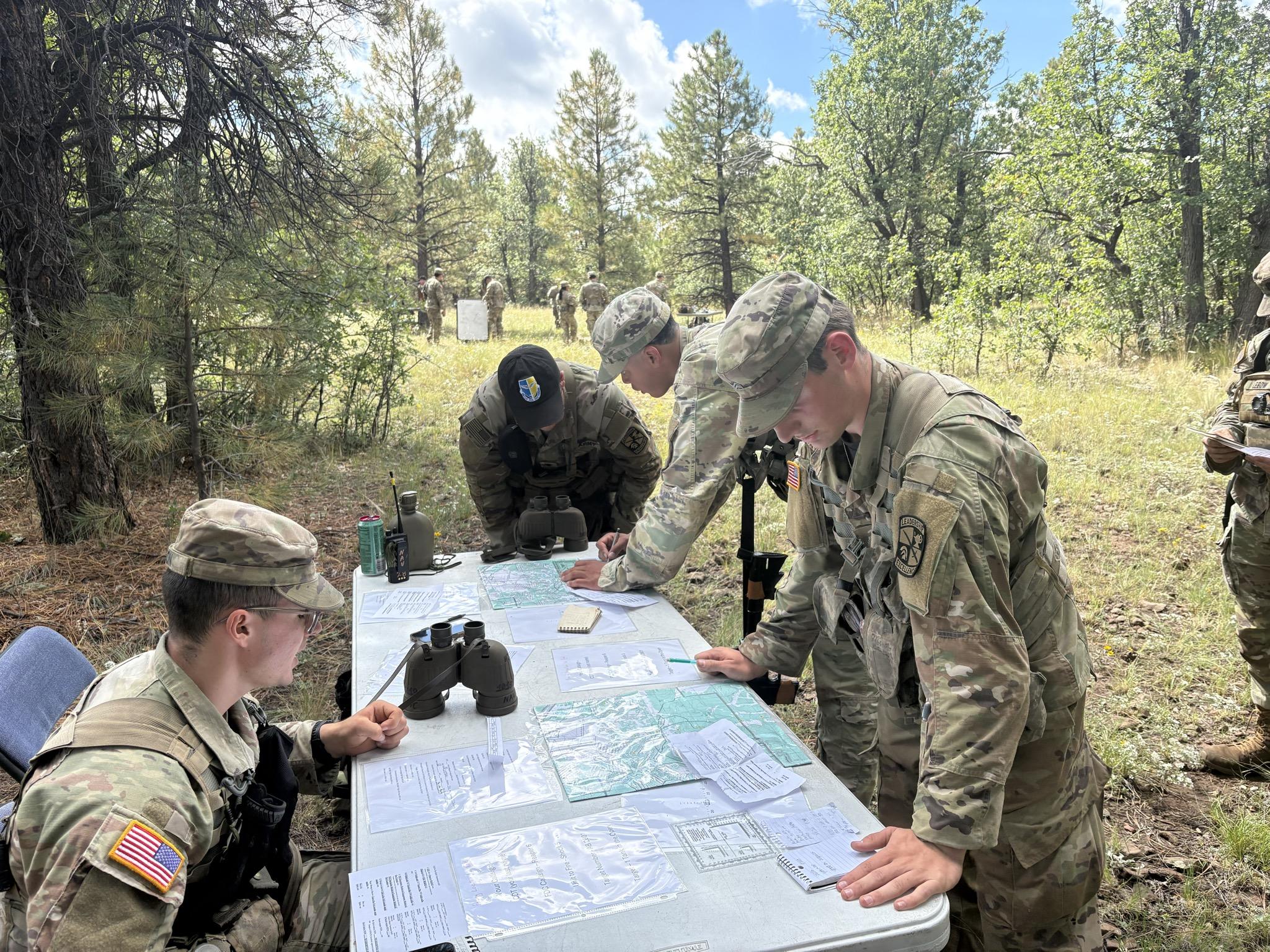
Every Officer receives specific training for their assigned job. Additionally, leadership training is available to all recruits. Officers attend specialized training called The Basic Officer Leader Course (BOLC) where they mentally and physically prepare for success as leaders in the Army.
After graduation, serve as an officer full-time on active duty in the Army or part time in the Army Reserve or Army National Guard. Take a look at a brief description of the differences below, and, for more details, see: Active Duty & Army Reserve or the Army National Guard website.
Active Duty Army
Serve full time for the duration of your service commitment, for the period specified in your contract, performing day-to-day operations with a specialized skillset in a specific field.
Army National Guard
Serve part-time at the state level protecting your local community or at the national level when required. The Army National Guard offers you work-life balance, flexibility, a paycheck, great benefits, and more
Army Reserve
Explore eligible unit vacancies in the United States to stay close to family and friends in a community you know while pursuing your career goals and serving your country part-time.
Army ROTC graduates are commissioned as U.S. Army Second Lieutenants. They then receive specialized training in an Army branch based on current branching procedures. During their Army careers, they’ll receive regular professional training as they advance through the ranks, and they’ll have many opportunities for advanced leadership positions, post-graduate education, and once in a lifetime experiences.
Branches by Category
The U.S. Army branches can be categorized into Operations, Operations Support, Force Sustainment, and Information Dominance, each focusing on different aspects of military operations.
Operations: The operations process involves planning, preparing, executing, and assessing a mission.
Operations support: Support operations ensure that military forces are ready and effective.
Force Sustainment: Sustainment operations provide the logistics, maintenance, and support needed to keep military forces ready and effective.
Information Dominance: Information dominance may be defined as superiority in the generation, manipulation, and use of information sufficient to afford its possessors military dominance.
Operations
Operations is where strategy meets action, the Army’s decisive edge on the battlefield. This group brings together the soldiers and leaders who plan, prepare, and execute missions that shape the outcome of every fight. Whether leading an infantry platoon, commanding a tank crew, coordinating artillery fire, or piloting helicopters through demanding conditions, Operations is about precision, adaptability, and courage under pressure.
These are the warriors at the center of every mission. Thinkers and doers who thrive in complex environments and make split-second decisions that determine success. From the first plan to the final execution, they embody the Army’s core values: teamwork, leadership, and the relentless drive to win.
This is the branch category for those who want to lead from the front; to inspire others, overcome challenges, and make an impact where it matters most.
Air Defense Artillery
The Air Defense Artillery branch protects U.S. forces, equipment and critical locations from enemy aircraft, missiles and drones. Air Defense Artillery officers use advanced radar, sensors and missile systems to detect, track and defeat aerial threats before they can strike. They provide early warning, coordinate with joint and allied forces and help control the airspace to keep soldiers safe on the ground. These officers play a key role in ensuring units can move freely, respond quickly and operate securely in combat and crisis environments.
Armor
The Armor branch provides the Army’s fast, powerful ground combat force. Armor officers lead tank and scout units that bring speed, firepower and protection to the fight. They find and defeat enemy forces, protect friendly troops and support infantry and other units. Armor officers are experts in combined-arms operations and lead from the front in demanding combat environments to help U.S. forces move, fight and win.
Chemical Corps
The Chemical Corps safeguards the force and the nation from chemical, biological, radiological, and nuclear (CBRN) threats, including weapons of mass destruction. Chemical officers and soldiers conduct detection, identification, protection, decontamination, and consequence-management operations to ensure units can survive and continue fighting in contaminated environments. They employ advanced protective systems, sensors, and analytical tools to assess hazards, advise commanders, and integrate with joint and interagency partners to defend against emerging global CBRN challenges.
Aviation
The Aviation branch provides the Army with air mobility, reconnaissance and precision fires. Aviation officers lead aircrews and maintenance teams that plan, coordinate and execute flight operations, including troop transport, medical evacuation, surveillance and attack missions. They ensure aircraft are mission-ready, manage airspace operations and deliver rapid and flexible capabilities across the battlefield.
Engineer Corps
Engineer officers combine technical expertise with tactical skill to support combat operations and build critical infrastructure. They enable friendly movement, deny mobility to the enemy and strengthen the Army’s ability to fight and win. Engineers construct and repair roads, bases and airfields; clear obstacles and hazards; build defensive positions; and employ demolitions. They also support large-scale civil and environmental projects and help restore essential services during humanitarian and disaster-relief missions.
Field Artillery
The Field Artillery branch delivers powerful and precise fire support for Army and joint forces, earning its title as the “King of Battle.” Field Artillery officers plan, coordinate and execute fires using cannons, rockets and missiles to destroy enemy targets and protect friendly troops. They use advanced sensors and digital fire-control systems to deliver accurate strikes, from close support on the ground to long-range attacks against high-value targets.
Infantry
The Infantry branch is the Army’s primary ground combat force and the core of close-combat operations. Infantry officers lead soldiers who close with and destroy the enemy, seize and hold key terrain, and dominate in all environments, from urban streets to remote mountains. They plan, synchronize, and execute missions across the full range of military operations in both war and peacetime, working alongside joint and allied forces. As tactical masters, Infantry leaders train their units to move, shoot, communicate, and win under the most demanding conditions.
Military Police
The Military Police Corps protects the force by enforcing law and order, securing Army installations and supporting missions at home and overseas. Military Police officers prevent crime, conduct investigations and ensure the safety and discipline of soldiers and families on post. When deployed, they provide route and area security, manage detainees, support customs missions and strengthen force protection, helping maintain stability and uphold the rule of law.
Operations Support
Behind every successful mission stands a team that makes success possible. Operations support is the Army’s backbone, ensuring that every soldier, system, and strategy is ready for action. These professionals coordinate logistics, manage equipment, deliver intelligence, and maintain secure communications across the force.
They’re the bridge between planning and performance, making sure that troops on the front line have exactly what they need, exactly when they need it. From intelligence analysts who uncover critical enemy movements to communications specialists who keep information flowing under pressure, operations support keeps the Army one step ahead.
This is where organization meets innovation. If you’re detail-oriented, mission-driven, and thrive on making complex systems work seamlessly, operations support is your battlefield.
Military Intelligence
The Military Intelligence branch gives commanders the information they need to make quick, informed decisions. Military Intelligence officers gather, analyze and share intelligence to protect U.S. and allied forces and counter enemy threats. They identify enemy plans and capabilities and use sensors, cyber tools and human intelligence sources to gain an information advantage, helping units anticipate and outmaneuver adversaries.
Signal Corps
The Signal Corps builds, operates, and secures the Army’s communication and information networks. Signal officers ensure commanders and soldiers can communicate anytime and anywhere, whether across a tactical battlefield or through secure digital networks that connect forces around the world. They lead teams that manage satellites, tactical radios, data systems, cybersecurity, and mission-command platforms, enabling rapid, reliable, and protected information flow across all domains.
Force Sustainment
Every mission depends on momentum, and force sustainment keeps that momentum alive. This group powers the Army from within, ensuring soldiers are equipped, supplied, and ready to fight. Sustainment is the lifeline of every operation; combining logistics, transportation, human resources, and financial management to keep the force strong and mission-ready.
These professionals make the impossible possible. They move fuel, food, ammunition, and equipment across challenging terrain, manage the flow of resources in real time, and ensure every soldier is cared for, paid, and supported. Even though they often work behind the scenes, they are embedded within operational units, standing shoulder-to-shoulder with those on the front lines.
If you’re someone who thrives on problem-solving, efficiency, and impact- someone who wants to make sure the Army never stops moving- force sustainment is where you’ll lead the mission from the inside out.
Adjutant General
The Adjutant General’s (AG) Corps manages the Army’s most important resource: its people. AG officers ensure soldiers and their families receive the administrative, personnel and human-resources support they need to stay ready, resilient and mission-focused. They help commanders build and maintain effective organizations by managing personnel systems, awards and promotions, strength reporting, casualty operations and soldier services across the force.
Finance
The Finance Corps manages the Army’s financial operations to keep units ready and missions moving. Finance officers oversee purchasing, contracting support, pay operations, auditing and accounting functions that ensure soldiers and organizations receive timely financial support. They work with military and commercial banking systems, manage vendor payments and operate financial-management systems that enable commanders to resource and sustain operations around the world.
Logistics
The U.S. Army Logistics Branch is responsible for planning, coordinating, and executing the sustainment of Army forces, ensuring that they are equipped, supplied, and maintained for operations both in peacetime and during wartime. It encompasses various functions like supply, maintenance, transportation, and field services, all working together to provide the necessary support for mission accomplishment.
Medical Services
The Medical Service Corps supports the Army’s medical mission by leading and managing health care operations across the force. Medical Service Corps officers plan, direct and oversee medical logistics, administration, patient movement, health services support and medical readiness programs. They help run clinics, hospitals and field medical units, and they advise commanders on medical planning, health care delivery and force health protection from garrison to the battlefield.
Information Dominance
In today’s fast-moving world, information is as powerful as any weapon. The Army’s information dominance group leads the charge in securing, shaping, and winning the digital battlespace. These experts control the invisible domain, protecting networks, countering cyber threats, and turning streams of data into real-time tactical advantage. Their mission is about speed, precision, and outthinking the enemy before the first move is made.
This is where the Army’s high-tech warriors thrive. They combine computer science, intelligence analysis, and strategic creativity to outpace adversaries across land, sea, air, space, and cyberspace. When the Army has the information edge, it owns the fight.
Cyber
The Cyber branch conducts defensive and offensive operations in cyberspace to protect Army networks, disrupt enemy systems and defend national interests. Cyber officers lead teams that identify and counter digital threats, secure critical infrastructure and execute operations that target adversary networks and capabilities. They work across the Army and with joint and interagency partners to deliver effects in the information and cyber domains.
Component, branch and unit placement depend on eligibility, available positions, Army needs and contract terms. Part-time service includes required training and may include mobilization.
Service Obligation
Scholarship recipients incur an eight-year service obligation, with active and reserve service requirements determined by the award and signed contract. Non-scholarship contracted cadets also have service requirements. The signed contract establishes the Active Duty, USAR, ARNG and Individual Ready Reserve requirements. Initial officer training and additional obligations for certain specialties form part of the service commitment.
Explore all officer careers at West Point · Army Virtual Branch Orientation
THE BASIC COURSE: TWO YEARS THAT WILL PREPARE YOU FOR THE YEARS TO COME
The Basic Course takes place during your first two years in college as elective courses. It normally involves one elective class and lab each semester along with the requisite physical training and field training exercises. You will learn basic military skills, the fundamentals of leadership, and start the groundwork toward becoming an Army leader. Taking Basic Course classes alone generally does not create a military service obligation; scholarship or contracting terms may create one.
FRESHMAN YEAR: PREPARING FOR SUCCESS AS AN ARMY OFFICER
Topics covered include:
Introduction to Army Leadership
Army Customs and Traditions
Military Operations and Tactics
Goal Setting and Accomplishment
Health and Physical Fitness
SOPHOMORE YEAR: THE ROLE OF AN OFFICER
Topics covered include:
Applied Leadership Theory
Communications
Principles of War
Military Operations and Tactics
THE ADVANCED COURSE: GRADUATE COLLEGE AS A FULL-FLEDGED LEADER
The Advanced Course takes place during your last two years in college as elective courses or as part of a Military Studies minor. It normally includes one elective class and lab each semester, requisite physical training, field training exercises, and a 35-day summer leadership camp at Fort Knox, Kentucky called Advanced Camp, which is required to commission as an Army Officer. You will learn advanced military tactics and gain experience in team organization, planning, and decision-making.
To benefit from the leadership training in the Advanced Course, all Cadets must have completed either the Basic Course or have attended Basic Camp at Fort Knox. A military service obligation is established by your scholarship and signed ROTC contract. Contracting, rather than attendance at Advanced Camp alone, establishes the applicable commitment.
JUNIOR YEAR: LEADING SMALL TACTICAL UNITS
Topics covered include:
Command and Staff Functions
Law of War
Weapons
Team Dynamics and Peer Leadership
Military Operations and Tactics
SENIOR YEAR: TRANSITION TO BECOMING AN OFFICER
Topics covered include:
Training the Force
Military Justice
Ethical Decision Making
Personnel Management
Cultural Awareness
Post and Installation Support
Military Operations and Tactics
Basic Camp
Basic Camp at Fort Knox is an accelerated alternative for eligible students who have not completed the Basic Course, including students joining ROTC later in college. The Army currently describes Basic Camp as 32 days and Advanced Camp as 35 days. Placement into the Advanced Course depends on completion of the Basic Course, Basic Camp or approved equivalent credit.
High school students
Apply for university admission, review Army ROTC scholarship opportunities, and speak with the ROTC recruiting team.
College students and transfers
Ask about enrollment, academic planning, scholarship availability, and how previous coursework affects your ROTC timeline.
Start ROTC at any stage of college.
Freshman or Sophomore
Basic Course
You’ll learn basic Army skills and what it takes to become a leader. The Basic Course normally involves one elective class and lab each semester, along with the required physical training and field training exercises.
Sophomore or Transfer
Basic Camp
You’ll practice becoming a leader in a team setting while getting helpful feedback to grow. Basic Camp is a 32-day intensive training event and accelerated alternative to the Basic Course that qualifies you for enrollment in the Advanced Course.
Junior or Senior
Advanced Course
You’ll learn advanced military strategies in a classroom setting and practice teamwork in preparation for Advanced Camp. Advanced Course requires completion of the Basic Course or Basic Camp and establishes your commitment to serve as an Army Officer after graduation.
Junior or Senior
Advanced Camp
You’ll be trained and tested through leadership development exercises in real-world scenarios. Advanced Camp is a 35-day rigorous field training event during the summer—and the most significant in your ROTC journey—which you must pass to qualify as an Army Officer.
Entry at a particular college year depends on degree time remaining, placement credit, medical and other eligibility requirements, and battalion approval. Contact the recruiting team to plan your route.
Explore Army ROTC joining pathways
Required Forms
- Cadet In-Processing Checklist
- Cadet Application and Enrollment Record (CC Form 139-R)
- Note: The CC Form 139-R is NOT a Contract that obligates the Cadet to a career in the Army. It is the proper registration information that is required for the Cadet to be “loaded” into the ROTC Cadet Command system. The information on the 139-R is also used to gather information for the Cadet to Contract and be eligible for benefits.
- Briefing on Government-Sponsored Benefits for ROTC Cadets (CC Form 136-R)
- Authorization for Access to Student Records (CC Form 137-R)
- Privacy Act Statement-Health Care Records (DD Form 2005)
- Record of Emergency Data (DD Form 93)
- State of Legal Residence Certificate (DD Form 2058)
- Servicemembers’ Group Life Insurance Election Certificate
- Direct Deposit Sign-Up Form
- FormW-4 (for current year)
- Army ROTC Contract of Indemnification and Release/Waiver of Liability
- Recruit/Trainee Prohibited Activities Acknowledgement (DD Form 2983)
- Medical Fitness Statement (DA Form 3425-R)
- Note: This form is mandatory prior to participating in any sort of physical activity with ROTC unless you have had a recent DOWMERB physical. School sports physicals will not be accepted in place of a medical fitness statement.
- Notarized Chicken Pox Statement
- Note: This form must be notarized. If you have not had chicken pox but have received the varicella vaccination and it is annotated on your vaccination record, you do not need to submit the Chicken Pox Form.
- Dental Exam Requirements Form/Authorization to Release Documents
- Foreign Language Form
Additional Documentation Required
- Social Security Card (we will make a copy and return)
- Original Birth Certificate or Certified True Copy (we will make a copy and return)
- Driver's License (we will make a copy and return)
- Immunization Record
- Copy of Final High School Transcript Indicating Date of Graduation
- SAT/ACT Scores
- Copy of Any Additional Transcripts (prior college)
- Scholarship Award Letter From Cadet Command (if applicable)
- Qualified DOWMERB Physical Paper (if applicable)
Scholar, Athlete, Leader (SAL)
The armed forces want individuals who are scholar-athlete-leaders (SAL) to serve as officers. They want students who have good grades, excel in sports and have served as a student or community leader.
Why?
These students show the mental and physical toughness and discipline required for leadership on the battlefield and in the boardroom.
Do you excel in everything you try? You might not have considered a life in the military. You may have your eye on climbing the business ladder, a professional sports career or a life in an elected office. The Army believes ROTC is the perfect stepping stone to a successful career in the real world.
Army ROTC is a leadership course that gives you the hands-on experience and skills that will help you succeed in your chosen career. After graduation, ROTC students are commissioned officers. You will put your leadership skills to the test every day, and when you leave the field of battle, you will be prepared for any career in the business world.
If you have the grades, the game and the guts, Embry‑Riddle's SAL program may have a place for you.
PAY FOR COLLEGE WITH THE ARMY’S HELP.
Cover your college education while gaining valuable leadership skills in Army ROTC with financial support from the Army.
GET TUITION COVERED 100%
Scholarships and other monetary support are available to help with costs when you join Army Reserve Officers’ Training Corps (ROTC). Focus on your education and graduate into a secure path as an Army Officer—and with less debt for the school years your scholarship covers. You’re eligible if you are a high school student enrolling in college, enrolled in college, or an active-duty enlisted Soldier. Get tuition and fees covered.
Get the full college experience, only with less debt, in exchange for a career serving in the Army as an Officer after graduation. ROTC scholarships are awarded based on academic achievements and can be applied to any of the 1,000+ participating schools, covering either tuition and fees or room and board.
GET MONEY FOR EXPENSES AND BOOKS.
Receive monthly help to offset living and book costs. All ROTC scholarships include an extra $420 each month throughout the school year for expenses like housing, along with $1,200 each year to spend on books.
YOUR OBLIGATION WITH AN ROTC SCHOLARSHIP
Your acceptance of the ROTC scholarship means a future service obligation of eight years in the Army, with requirements for active duty and/or the Army Reserve or Army National Guard depending on the scholarship. You may be eligible to serve part time in the Army Reserve or Army National Guard while pursuing a civilian career immediately after graduation.
Withdrawal, repayment and service requirements are governed by the signed scholarship contract, including any applicable freshman-year withdrawal provision.
ROTC SCHOLARSHIP REQUIREMENTS
To be eligible for any ROTC scholarship, you must meet these standards.
Be a U.S. citizen
Be at least 17 and under 31 in year of commissioning
Have a high school diploma or equivalent
Have an unweighted high school GPA of at least 2.50 if you’re in high school while applying
Have taken the SAT or ACT
Complete the scholarship applicant Physical Fitness Assessment (PFA). Cadets must meet applicable Army Fitness Test (AFT) and body-composition requirements for contracting and commissioning.
Meet the physical waist-to-height ratio (WHtR) standards
Agree to accept a commission and serve in the Army, Army Reserve, or Army National Guard
Scholarship Benefits
Scholarships provide full tuition and authorized fees OR room-and-board support, rather than both. Scholarship cadets receive a $1,200 annual book allowance ($600 per semester) and a $420 monthly living allowance for 10 months of the school year. Cadet Command also provides the living allowance to eligible non-scholarship contracted cadets in their second, third and fourth years. Covered expenses and payment conditions follow the award terms.
GREEN TO GOLD: ENLISTED SOLDIER SCHOLARSHIPS
As an enlisted Soldier, you have access to the Green to Gold program and scholarship opportunities to cover costs for tuition or room and board, while you earn your undergraduate or graduate degree.
CHANGE YOUR PATH. THEN, LEAD THE WAY.
If you join the Army as an enlisted Soldier and later want to commission as an Officer, the Green to Gold program can help you get there.
GO FROM SOLDIER TO ARMY OFFICER.
Green to Gold is a program designed for current active-duty enlisted Soldiers to earn a four-year bachelor’s degree or a master's degree and make the switch to the Officership path of the Army.
If you're an enlisted Soldier, Army ROTC can help you continue to grow and learn. The Army Green to Gold program provides options for Soldiers interested in pursuing a baccalaureate or graduate degree and earning a commission as an Army Officer.
OPTIONS FOR GREEN TO GOLD
Active-duty enlisted Soldiers have four options through the Green to Gold program to earn a degree while serving. Work with an ROTC recruiter to help determine which option is right for you.
OPTION 01 GREEN TO GOLD SCHOLARSHIP
Get full tuition or room and board, flat-rate book payment, and a monthly stipend if you want to leave active duty to attend college. This scholarship is awarded for two to four years depending on how many years of college you've already completed.
OPTION 02 GREEN TO GOLD ACTIVE-DUTY OPTION
If you're an eligible and enlisted Soldier, you can remain on active duty and continue to serve while you attend college and earn your commission as an Army Officer. This is a two-year program.
OPTION 03 ARMY ROTC GREEN TO GOLD DIVISION COMMANDER’S HIP POCKET SCHOLARSHIP
This selective program lets you complete your bachelor’s degree through the ROTC Scholarships program, where your chain of command can recommend you for outstanding service or exhibiting potential for the program.
OPTION 04 GREEN TO GOLD NON-SCHOLARSHIP
If you want to leave active duty to attend college, you’ll receive a monthly stipend during school and commission as an Army Officer when you earn your degree. You can work with your local leadership to see if this option is available to you.
REQUIREMENTS TO QUALIFY FOR THE GREEN TO GOLD PROGRAM.
Green to Gold eligibility is specific to the selected option. The 2026–27 Active-Duty Option and Scholarship/Hip-Pocket handbooks require U.S. citizenship, a GT score of at least 110, medical qualification, and the required academic and military eligibility.
Applicants must pass the AFT after the application period opens and meet AR 600-9 standards. The handbooks require body-fat measurement for all applicants and do not permit permanent profiles or alternate fitness events.
ADO applicants need enough academic credit for junior or graduate-student standing and normally a college GPA of at least 2.5; GPA waivers are available only within the handbook’s specified range. Scholarship/Hip-Pocket and ADO age, service-time and waiver rules differ. The option’s handbook provides the complete eligibility and application requirements.
2026–27 Active-Duty Option handbook · 2026–27 Scholarship/Hip-Pocket handbook
HOW CAN CURRENT ENLISTED SOLDIERS APPLY FOR GREEN TO GOLD?
If you’re an active-duty enlisted Soldier interested in applying for a Green to Gold program, talk to your commanding Officer and visit the Cadet Command Green to Gold site: Green to Gold (https://armyrotc.army.mil/green-to-gold/) to start your application.
Active-Duty Option: Eligible selected Soldiers remain on active duty while completing the two-year program and continue receiving authorized pay and allowances. ADO is distinct from the scholarship option; program participation also has specific time-in-service and retirement-credit rules.
Contact Us
MAJ Brouthers — BROUTHEC@erau.edu
Ms. Connie — colvi6ac@erau.edu
CPT Hibler — HIBLERM@erau.edu
Find Army ROTC
Prescott Campus, Building 70C